TWO PARTIES, OPPOSITE CLOCKS
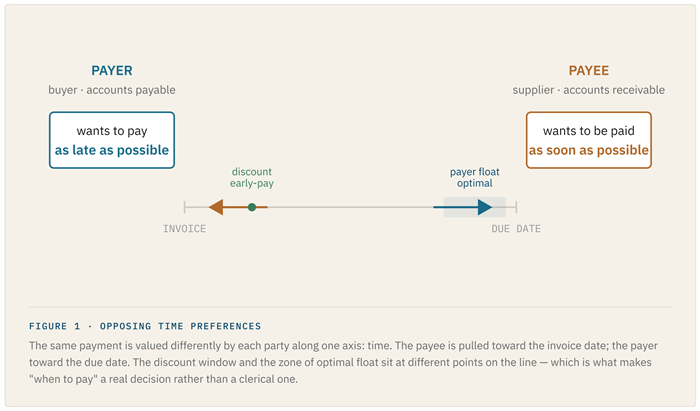
Every business-to-business payment involves conflicting incentives. The payer wants to hold cash as long as possible, preserving working capital and the value of float. The payee wants the cash as soon as possible for the same reason. Both are trying to do the same thing: optimize their own cash and working capital, from opposite perspectives. When the payment is made, the tension is resolved.
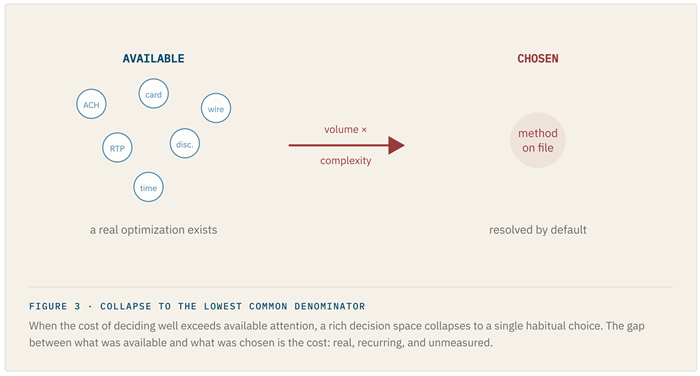
This resolution is rarely reached on merit. It is reached by default — whatever method happens to be on file, executed whenever someone gets to the invoice. The disagreement is real and has real economic content, but the benefit of optimizing on a single invoice is small, and the complexity involved can be significant. So the problem gets settled instead of solved.
HIDDEN COMPLEXITY
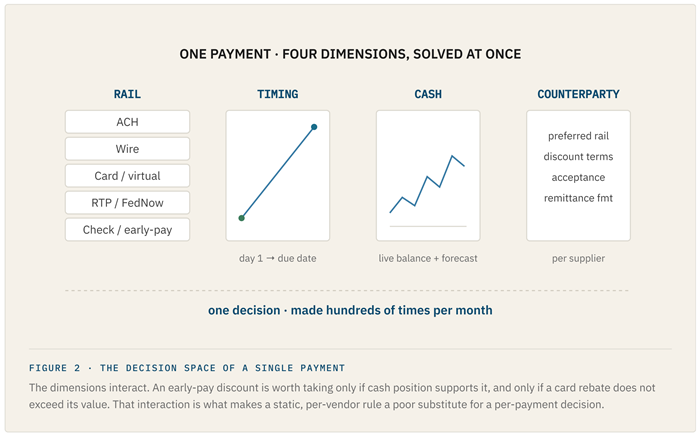
There is no single way to pay. ACH, wire, real-time payments, physical and virtual cards, digital and paper checks, push-to-card, and a range of cross-border schemes each carry their own cost, cutoff times, settlement timing, risk, failure modes, and remittance requirements.
Layer on variable terms, dynamic discounting, supply-chain finance, and factoring, each with an implied annualized rate that has to be weighed against the payer's own, ever-changing cost of capital, and a single payment becomes a small multi-variable optimization: whom to pay, when, how much, by what method, on what day, against what cash position, on which terms. The payee faces the mirror image, optimizing the same variables from the receiving side.
WHY THE PROBLEM GOES UNSOLVED
The optimization potential is real. It is also, at the level of the individual invoice, beyond the bandwidth of the people responsible for it. A mid-market finance team running a few hundred payments a month cannot compute the optimal rail and timing for each one against a live cash forecast. So they do not, and neither do the several million other US businesses in the same position. The payment is handled operationally, with the simplest process that works, rather than being addressed as an optimization problem.
The losses — missed discount windows, float surrendered early, a wire fee where ACH would have served, working capital tied up without reason — are not measured or considered. This is not negligence, just the natural result of the value of optimizing each invoice/payment being less than the human attention required to do so.
WHAT AN AGENT CAN DO
AI agents have tremendous potential to streamline financial operations. To name just a few use cases: For accounts payable (AP), they can truly automate the invoice-to-pay cycle from start to finish: capturing and coding invoices, routing for approval, flagging potential issues, and recommending payment. For accounts receivable (AR), they can plan and execute bespoke collections workflows, personalized for specific customers and automate cash application for incoming payments. Agents can also alter the fundamental economics that rendered this payment optimization problem unsolvable.
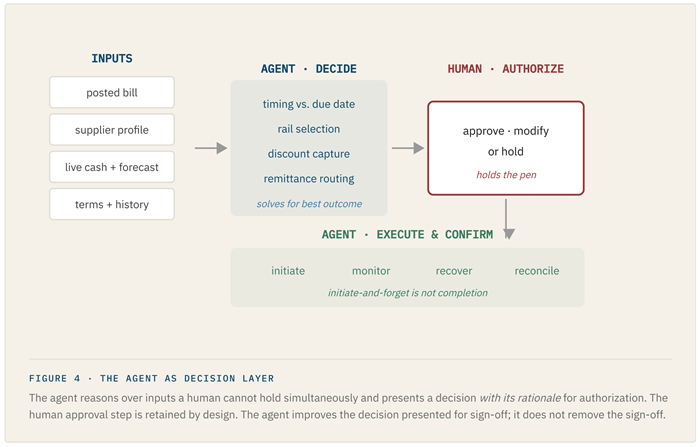
Picture an agent assigned a single task for every payment: optimize the cash position of each counterparty. The moment a bill is posted, it evaluates it. It builds a full, accurate profile of the supplier, verifying identity, gathering accepted methods and standing terms. It assembles the optimization from the inputs that actually matter: amount, due date, supplier profile, relationship and payment history, the buyer's own revenue and cash position. It reads the thirteen-week cash forecast, building one if none exists. Where it makes sense, it engages the supplier to negotiate an early-payment discount. It selects a payment date and a rail that sits inside both counterparties' tolerances. And it recommends a course of action (pay this much, on this date, by this method) with a clear, auditable justification. And it can do this continuously, cheaply for every payment, across the whole queue.
The agent solves the problem; it does not move money without oversight. Segregation of duties, authorization policy, and audit expectations are features of a sound payment process, not friction to engineer away. The agent's contribution is to make the decision presented for sign-off a better one, with its reasoning visible and auditable. It does not remove the sign-off.
WHAT SOLVING IT IS WORTH
Assume the agent does nothing heroic, only what a person would do with unlimited time. It improves the payer's days payable by a few days and the payee's days to cash by a few days, and it captures the discounts that volume currently causes to slip. Crucially, it does this without either payer or payee squeezing the other side: it recovers slack that complexity leaves on the table. The gain is not a transfer between counterparties. It is recovered waste, value that simply was not being captured by anyone.
First, consider the benefits at the level of a single firm with $50M in revenue: (The numbers below are intended for illustrative purposes, to estimate the opportunity, not forecasts or claims of realized results)
The firm as payer:
- Addressable AP spend (≈65% rev) $32.5M
- +3 days DPO → working capital freed ~$267K
- Better discount capture (50%→90%) ~$78K / yr
The same firm as payee:
- Annual receivables $50.0M
- −2 days DSO → cash forward ~$274K
- −3 days DSO → cash forward ~$411K
The same firm sits on both sides of the network. Its agent improves its payables; its customers’ agents improve its receivables. The benefit compounds as adoption spreads. A single mid-market firm recovers roughly a quarter to half a million dollars of liquidity on each side, plus tens of thousands in recurring margin from an improvement it was always entitled to but never had the capacity to perform.
Now consider the US economy as a whole. The ACH network cleared ~$93T in 2025, implying an average of $255B per day flowing through the network (source: NACHA). A mere three-day improvement in days outstanding frees up $765B in liquidity. Of course, the ACH network is not limited to B2B payments, but neither does it contain all B2B volumes.
A few days of working capital, recovered across the volume of payments that move through the economy, is a lot more than a rounding error. It is a structural gain in how efficiently liquidity is allocated, achieved without anyone borrowing a cent and without one side gaining at the other's expense.
SEE WHERE THE MARKET IS HEADING
Centime puts this kind of intelligence to work across the entire finance function. Best-in-class AP, AR, cash forecasting, and expense management combine in one integrated, AI-driven platform.
Learn what Centime's platform can do for you.