Talent at Risk
It’s 2014, do you know where your people are...really?
Talent management is a neat and tidy term to a very complex and messy issue: people. While today’s unemployment rates still hover around 6.5 to 7 percent, it’s not that there is a lack of people, but mostly a lack of the right people. This situation will only get worse as globalization, multi-generational workforces and competitive pressures increase among all sectors and industries. No wonder talent places in the top three worries senior leaders face. The question remains, while we continue to worry about it, are we really doing anything about it?
The answer is mixed. Recently, KPMG and Brandon Hall Group surveyed more than 1200 Human Resource (HR) talent, learning and business executives across 54 developed and developing countries. In a nutshell, here is what we heard.
Five categories of risk
The survey uncovered five areas of risk:
Growing capability—Can the organization build the skills it needs to compete both now and in the future?
Realistic cost—Will the company be able to afford to recruit and retain the people it needs?
Meaningful compliance—Do talent processes comply with local laws and regulations? Is compliance seen as a critical process or simply an administrative process?
Future capacity—Do you feel you have solid succession and retention strategies for critical people and teams moving forward?
Emotional connection—Is your top talent engaged? Engaged in a way that is viral across the company?
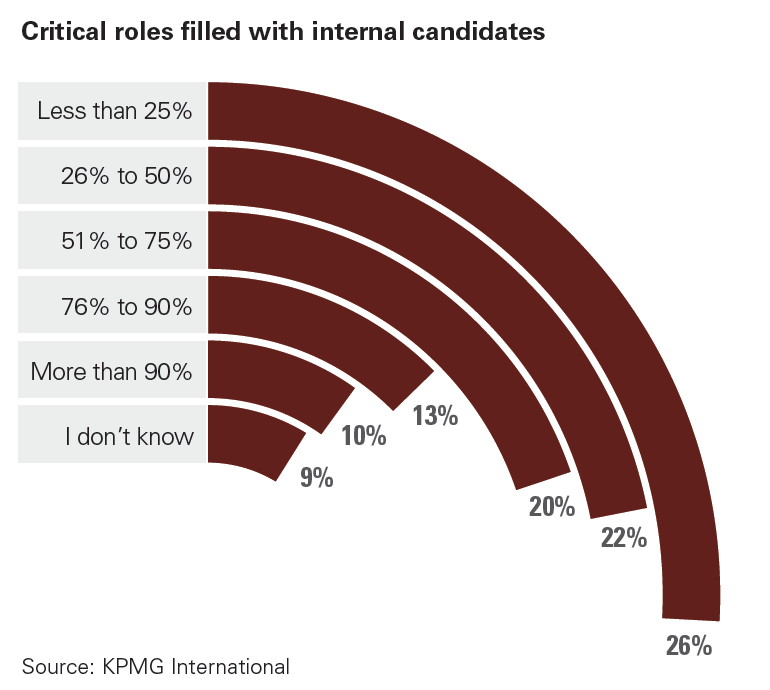
Despite the increasing concern for talent, many organization take a narrow, short-term approach and point solutions ignoring the need to approach people efforts in a broader, more sustainable way—one that aligns more closely with their organization’s strategic needs. As the following chart shows, short-term thinking creates a dearth of people ready and capable to move into more critical roles.
Whose job is it anyway?
Capacity and capability topped the list of executive worries, and rightly so. With today’s “do more with less” mentality, the tried and true management techniques of yesteryear have nearly disappeared.
Today, performance management isn’t seen as ongoing or instructive, but rather a box to check. Business leaders have tended to lose their ability to engage with, motivate and develop business-critical talent. Furthermore, the budgets for internal and external education and training have been slashed. It’s no wonder the best and the brightest move on. So rather than filling leadership positions with people who are gaining institutional knowledge and talent for the long-term, companies are increasingly forced to look outside, wreaking havoc with retention and succession planning.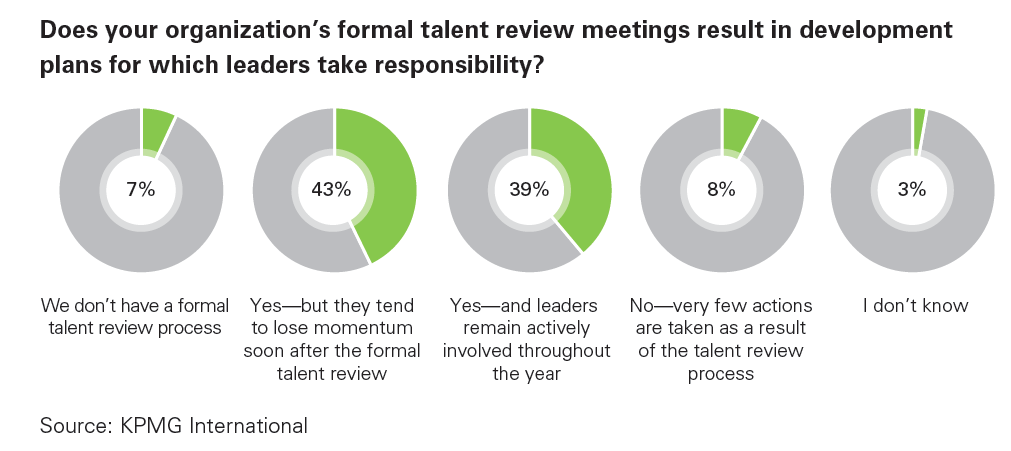
Missing the connection
In October 2013, The Wall Street Journal carried a story about Gallup’s latest findings on employee engagement. Across 142 countries, only 13 percent of workers said they were engaged in their work.
This lack of engagement is very disturbing considering how well established the correlation is between engaged employees and satisfied customers. You would never hear a CEO say they were unconcerned by customers’ perception of their brand, but it is precisely the people who work for you that determine the quality of your brand. They are any company’s most important touch points. While some leaders take this very seriously, many really don’t as you can see by the responses.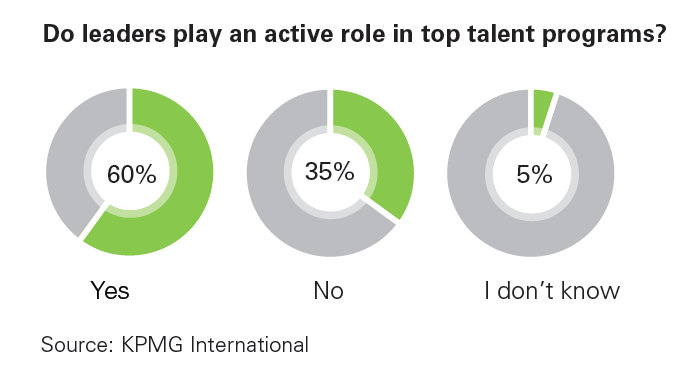
Talent costs money
Can you afford the cost of your workforce now, 5 or 10 years from now? Two cost related issues were of high concern in our survey:
• Unsustainable salary expectations of candidates with critical skills
• An insufficient budget for managing and developing talent
However, once again, it is equally if not more useful to take a look at what respondents said they were not worried about. Specifically, they were unconcerned about the total cost of the workforce becoming unsustainable in relation to current revenues.
Our data finds that many businesses do not even track the real cost of the workforce as a key metric. Over 62 percent of organizations either don’t track total cost of workforce at all, or they use it only in a limited scope—and this did not change dramatically for company size.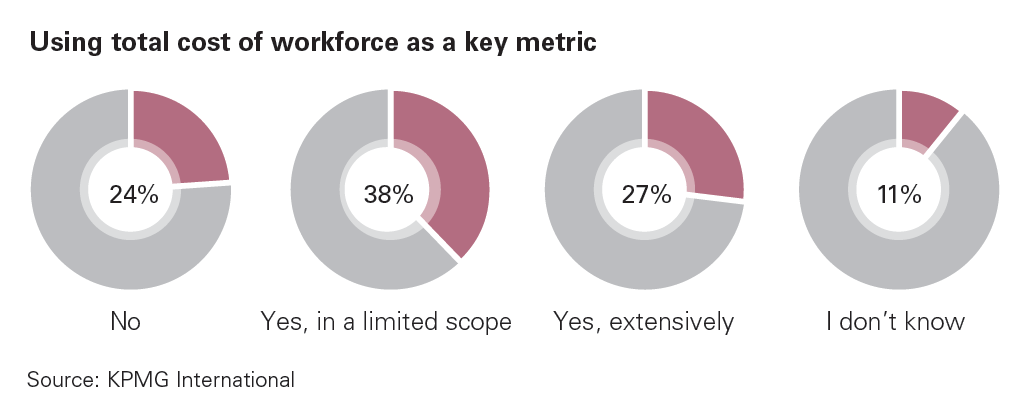
One executive put this into perspective:
“After three to five years, a college graduate will leave us. It used to cost approximately half their salary to train their replacement. Now it’s probably closer to $350,000. That’s a tremendous amount of money you’re going to have to spend if you don’t want to hire the right person, and then to keep them engaged and motivated to continue working for you and developing themselves with the goal of progressing through your company—instead of out the door.” —E-learning manager on the retail side of a medium-sized US-based specialty manufacturer.
At present, talent managers appear to be approaching workforce costs from merely a short-term perspective and one that’s overly focused on capacity and capability.
Yet, from a cost perspective, it would be better to take a broader approach that also considers connection-related talent risks, such as employee engagement, and compliance-related talent risks, such as how effectively they’re tackling performance management—thereby driving down attrition, strengthening their employer brands—and, ultimately, reducing overall costs.
After all, it’s going to be a great deal more cost-effective to engage, develop and progress employees to the point where they want to keep working for you than it is to see them walk out the door.
What needs to happen now
Recruit differently—With the most desirable people in short supply, employers have to look beyond their traditional approaches to recruitment. Going to the same universities and looking at the same demographics keeps your efforts in a shrinking talent pool. Young populations throughout Africa, and in particular, places like Egypt have highly educated young people with very high unemployment. Women looking to return to the workplace represent a rich talent pool, often forgotten. It’s all about new thinking and untapped talent pools.
Innovate and flatten—And speaking of new thinking, employers need to become flatter in order to encourage innovation. Most organizations simply have too many layers between the person with a bright idea and the person who can recognize, sponsor and fund that bright idea.
Value people as a form of currency—Talent does contribute to a company’s profits and losses. Finding a way to measure the value of each person and each team in pursuit of the company’s strategy and performance is a key responsibility for every line leader and HR executive.
View talent as a long-term proposition—The organization is nothing, if not for the individuals who make the difference to innovation, customer loyalty and operational integrity. Executives didn’t get there in isolation or as part of a number on a balance sheet. Someone—many someone’s—invested in them along the way, nurtured their ideas, gave them critical feedback and created the environment for them to become who they are today.
Download KPMG’s Global Talent Risk report.
Sig Shirodkar is the Talent Management Lead of Advisory Services at KPMG LLP, the U.S. audit, tax and advisory firm.